
[Solved]Question 2 Imagine Antenna Whose Bandwidth Limited Happen Pick Noise Raw Audio Sounds Like Q37031174
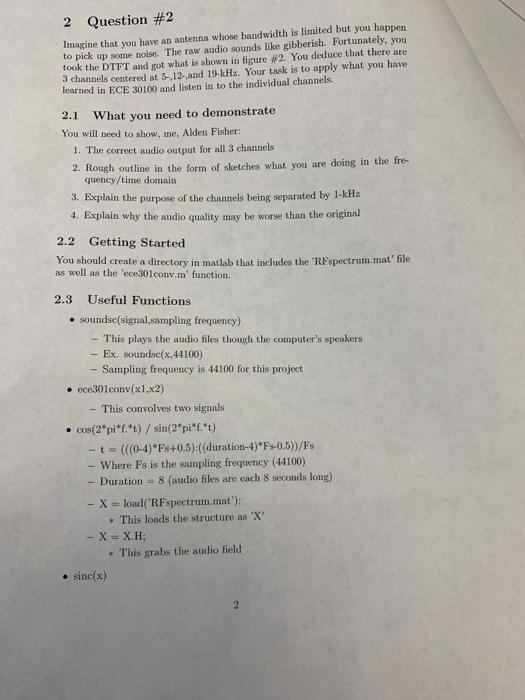
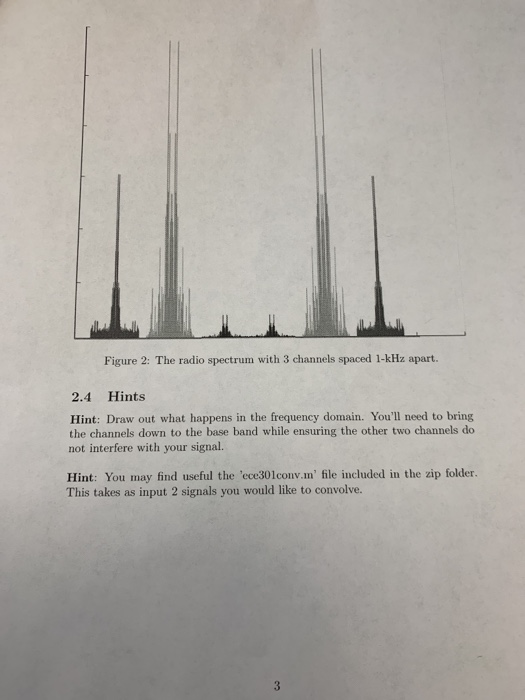
Question #2 Imagine that you have an antenna whose bandwidth is limited but you happen to pick up some noise. The raw audio sounds like gibberish. Fortunately, you took the DTFT and got what is shown in figure #2. You deduce that there are 3 channels centered at 5-,12-,and 19-kHx. Your task is to apply what you have learned in ECE 30100 and listen in to the individual channels 2.1 What you need to demonstrate You will need to show, me, Alden Fisher: 1. The correct audio output for all 3 channels 2. Rough outline in the form of sketches what you are doing in the fre- quency/time domain 3. Explain the purpose of the channels being separated by 1-kHz 4. Explain why the audio quality may be worse than the original 2.2 Getting Started You should create a directory in matlab that includes the RFspectrum.mat’ file as well as the ‘ece301conv.m’ function. 2.3 Useful Functions . soundsc(signal,sampling frequency) – This plays the audio files though the computer’s speakers – Ex. soundsc(x,44100) – Sampling frequency is 44100 for this project . ece301 conv(xl,x2) – This convolves two signals . cos(2*pi’f.’t) /sin(2*pi”f’t) -t= (((0-4)”Fs+0.5):((duration-4)”F-0.5))/Fs – Where Fs is the sampling frequency (44100) – Duration 8 (audio files are cach 8 seconds long) – X -load(‘RFspectrum.mat’); ds the s * This grabs the audio field * This loads the structure as ‘X’ sinc(x) Figure 2: The radio spectrum with 3 channels spaced 1-kHz apart 2.4 Hints Hint: Draw out what happens in the frequency domain. You’ll need to bring the channels down to the base band while ensuring the other two channels do not interfere with your signal. Hint: You may find useful the ‘ecc3Olcov.m, file İncluded in the zip folder. This takes as input 2 signals you would like to convolve. ece301conv.m- Wolfram Mathematica 11.1 File Edit Insert Format Cell Graphics Evaluation Palettes Window Help Debug Run A Function sv | | Sectionv | | Update -ece3e1conv (x1,x2) function [ I y duration- 8; xle (x1 zeros (size (x1))1 xže-[x2 zeros (size (x2)21 fxle-fft (xle); fx2e-fft (x2e) fye fxle..fx2e; ye ifft (fye) y ye (floor length (x1) /2) (1:length (x1)1)/length(x1) duration; Show transcribed image text Question #2 Imagine that you have an antenna whose bandwidth is limited but you happen to pick up some noise. The raw audio sounds like gibberish. Fortunately, you took the DTFT and got what is shown in figure #2. You deduce that there are 3 channels centered at 5-,12-,and 19-kHx. Your task is to apply what you have learned in ECE 30100 and listen in to the individual channels 2.1 What you need to demonstrate You will need to show, me, Alden Fisher: 1. The correct audio output for all 3 channels 2. Rough outline in the form of sketches what you are doing in the fre- quency/time domain 3. Explain the purpose of the channels being separated by 1-kHz 4. Explain why the audio quality may be worse than the original 2.2 Getting Started You should create a directory in matlab that includes the RFspectrum.mat’ file as well as the ‘ece301conv.m’ function. 2.3 Useful Functions . soundsc(signal,sampling frequency) – This plays the audio files though the computer’s speakers – Ex. soundsc(x,44100) – Sampling frequency is 44100 for this project . ece301 conv(xl,x2) – This convolves two signals . cos(2*pi’f.’t) /sin(2*pi”f’t) -t= (((0-4)”Fs+0.5):((duration-4)”F-0.5))/Fs – Where Fs is the sampling frequency (44100) – Duration 8 (audio files are cach 8 seconds long) – X -load(‘RFspectrum.mat’); ds the s * This grabs the audio field * This loads the structure as ‘X’ sinc(x)
Figure 2: The radio spectrum with 3 channels spaced 1-kHz apart 2.4 Hints Hint: Draw out what happens in the frequency domain. You’ll need to bring the channels down to the base band while ensuring the other two channels do not interfere with your signal. Hint: You may find useful the ‘ecc3Olcov.m, file İncluded in the zip folder. This takes as input 2 signals you would like to convolve.
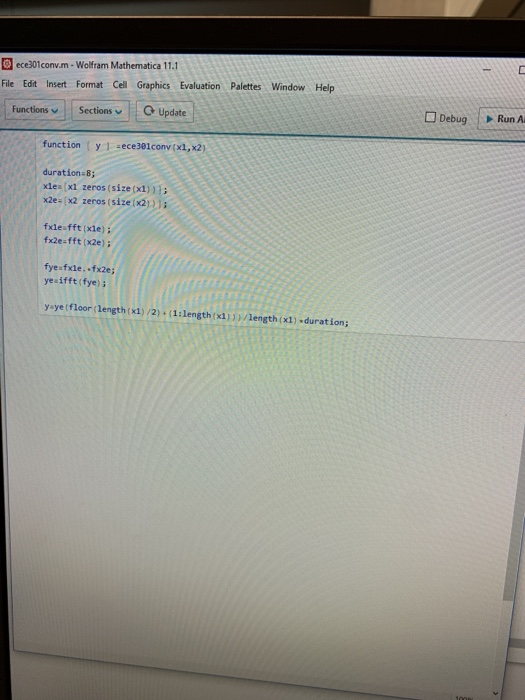
ece301conv.m- Wolfram Mathematica 11.1 File Edit Insert Format Cell Graphics Evaluation Palettes Window Help Debug Run A Function sv | | Sectionv | | Update -ece3e1conv (x1,x2) function [ I y duration- 8; xle (x1 zeros (size (x1))1 xže-[x2 zeros (size (x2)21 fxle-fft (xle); fx2e-fft (x2e) fye fxle..fx2e; ye ifft (fye) y ye (floor length (x1) /2) (1:length (x1)1)/length(x1) duration;
Expert Answer
Answer to Question #2 Imagine that you have an antenna whose bandwidth is limited but you happen to pick up some noise. The raw au… . . .
OR