
[solved]-Need Help Lab Involving Multiset Datastructures Java Purpose Assignment Demonstrate Develo Q39020376
So I need help with a lab involving multiset datastructures injava. The purpose of the assignment is to demonstrate/developmastery with basic data structures and the use of generics.
PROBLEM: A multiset is an unordered collection of object drawnfrom some data domain. Multisets differ from sets primarily in thata multiset is allowed to contain multiple instances of the sameelement. For example, a multiset of integers might be depicted asfollows: {-3, 1, 1, 2, 5, 5, 10}. A multiset of Strings could be{“ball”, “pie”, “apple”, “pie”}. Notice that a multiset consists ofa core collection of unique items (which can be referred to as theunderlying set/ elements.) For example, underlying set in themultiset of integer example is {-3, 1, 2, 5, 10}. There are twoways to standard ways to display a multiset. The first approach isto just list all the elements including the duplicates. The secondapproach is to list order pairs of each underlying elements with acount of the number of times each element appears. So we coulddisplay our multiset of integers example as:
{-3, 1, 1, 2, 5, 5, 10} or {(-3, 1), (1, 2), (2, 1), (5, 2),(10, 1)}
The design requirements of the lab is to implementent themultiset data structure. The basic operations on multisets are:length, union, intersection, difference, join, unique, andoccurrence. The effect of each of these operations is defined asfollows:
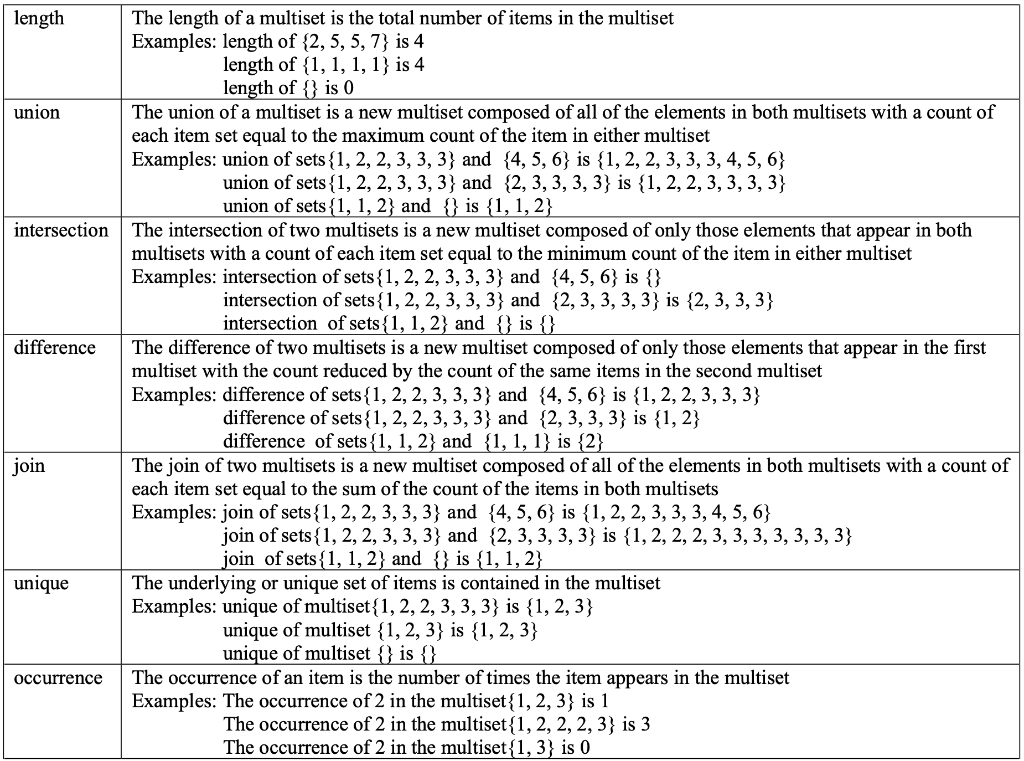
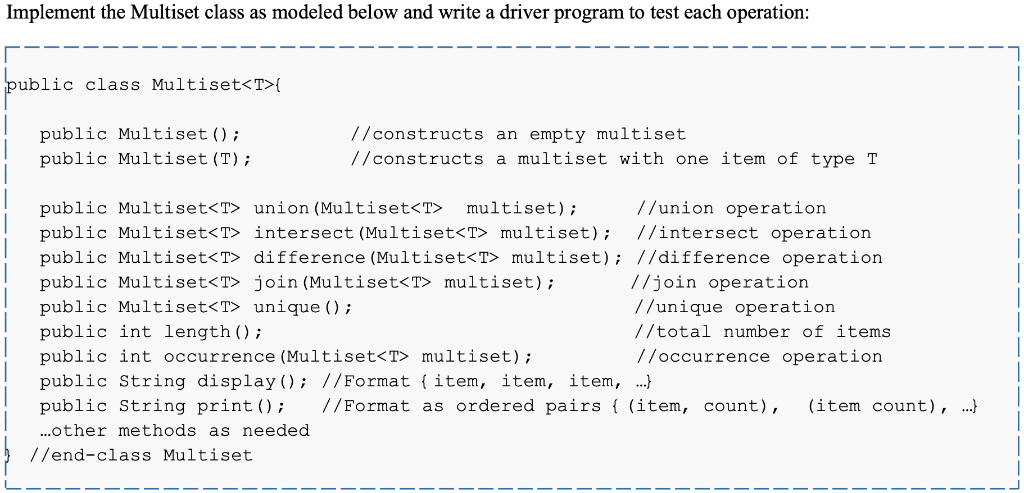
The UML for the Project is found below:
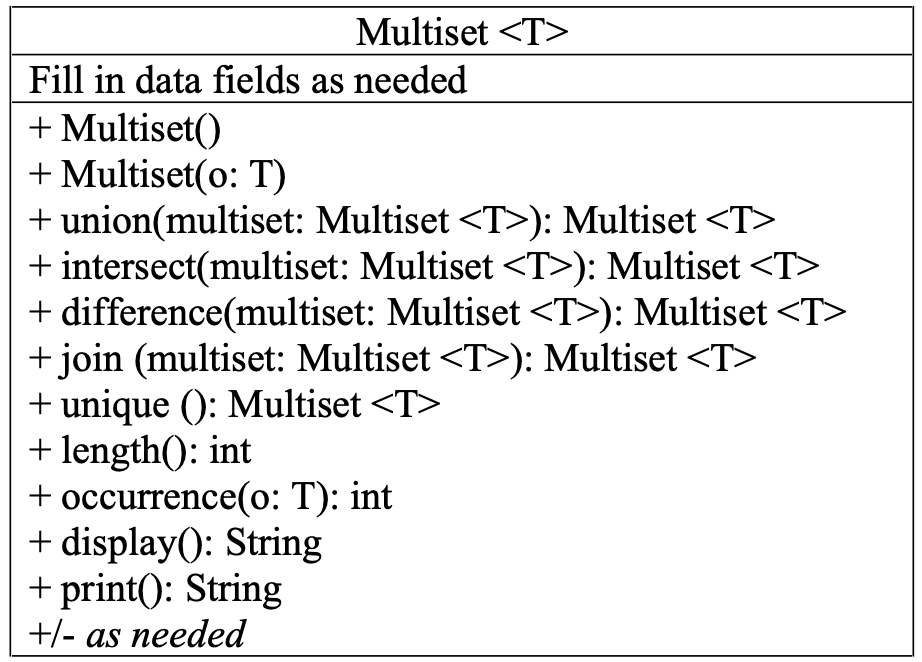
ALSO: You are not to assume that there is anyrestriction on the size (number of elements) or type of valuesstored for which one might wish to use your multiset. The user willdefine the type using a generic when instantiating theclass/reference variable.
IMPORTANT: The goal of this project is for youto implement a data structure/type. Thus, you MAYNOT use any existing data structure more complicated thanan array. You are welcome to use any API methods that operator onarrays (such as those in java.util.Arrays). You can NOT use, forexample, an ArrayList or other preprogrammed solution that performsa similar function. You may not use any preprogrammed solutions(API or otherwise) which directly does any of the methods/functionsdescribed above. You must write the code which implements allfunctionality.
Thank you for your help and programs that work will recieve athumbs up for sure!!
length The length of a multiset is the total number of items in the multiset Examples: length of {2, 5, 5, 7} is 4 length of 1, , 1, 1} is 4 length of } is 0 The union of a multiset is a new multiset composed of all of the elements in both multisets with a count of each item set equal to the maximum count of the item in either multiset Еxamples: union of sets {1, 2, 2, 3, 3, 3} and {4, 5, 6} is {1, 2, 2, 3, 3, 3, 4, 5, 6} union union of sets1, 2, 2, 3, 3, 3} and {2, 3, 3, 3, 3} is {1,2, 2,3, 3, 3, 3} union of sets1, 1, 2} and {} is {1, 1, 2} intersection The intersection of two multisets is a new multiset composed of only those elements that appear in both multisets with a count of each item set equal to the minimum count of the item in either multiset Examples: intersection of sets1, 2, 2, 3, 3, 3} and {4, 5, 6} is {} intersection of sets{1, 2, 2, 3,3,3} and {2, 3, 3, 3, 3} is {2, 3, 3, 3} intersection of sets{1, 1,2} and {} is {} difference The difference of two multisets is a new multiset composed of only those elements that appear in the first multiset with the count reduced by the count of the same items in the second multiset Examples: difference of sets{1, 2,2,3, 3,3} and {4, 5, 6} is {1, 2,2, 3,3, 3} difference of sets{1,2,2, 3, 3,3} and {2, 3,3, 3} is {1, 2} difference of sets{1, 1, 2} and {1, 1, 1} is {2} The join of two multisets is a new multiset composed of all of the elements in both multisets with a count of each item set equal to the sum of the count of the items in both multisets Examples: join of sets{1,2,2, 3, 3, 3} and {4, 5, 6} is {1,2, 2, 3, 3, 3,4, 5, 6} join join of sets 1, 2, 2, 3, 3, 3} and {2, 3,3, 3,3} is {1,2, 2,2,3, 3, 3, 3, 3, 3,33 join of sets{1, 1,2} and {} is {1,1,2} The underlying or unique set of items is contained in the multiset Examples: unique of multiset{1,2,2, 3, 3, 3} is {1, 2,3} unique of multiset {1, 2, 3} is {1, 2, 3} unique of multiset {} is {} unique The occurrence of an item is the number of times the item appears in the multiset Occurrence Examples: The occurrence of 2 in the multiset{1,2, 3} is 1 The occurrence of 2 in the multiset{1,2, 2,2,3} is 3 The occurrence of 2 in the multiset{1, 3} is 0 Implement the Multiset class as modeled below and write a driver program to test each operation: public class Multiset<T>{ public Multiset (); public Multiset (T); //constructs an empty multiset //constructs a multiset with one item of type T //union operation //intersect operation public Multiset<T> union (Multiset<T> multiset); public Multiset<T> intersect (Multiset<T> multiset); public Multiset<T> difference (Multiset<T> multiset); //difference operation public Multiset<T> join (Multiset<T> multiset); public Multiset<T> unique (); //join operation //unique operation public int length(); public int occurrence (Multiset<T> multiset); //total number of items //occurrence operation public String display () ; //Format { item, item, item, ..} public String print (); //Format as ordered pairs { (item, count), (item count), ..} …other methods as needed //end-class Multiset Multiset T> | Fill in data fields as needed Multiset( Multiset(o: T) union(multiset: Multiset <T>): Multiset <T> intersect(multiset: Multiset <T>): Multiset <T> difference(multiset: Multiset <T>): Multiset <T> join (multiset: Multiset <T>): Multiset <T> unique : Multiset <T> length(): int occurrence(o: T): int display( String print(: String +/- as needed Show transcribed image text length The length of a multiset is the total number of items in the multiset Examples: length of {2, 5, 5, 7} is 4 length of 1, , 1, 1} is 4 length of } is 0 The union of a multiset is a new multiset composed of all of the elements in both multisets with a count of each item set equal to the maximum count of the item in either multiset Еxamples: union of sets {1, 2, 2, 3, 3, 3} and {4, 5, 6} is {1, 2, 2, 3, 3, 3, 4, 5, 6} union union of sets1, 2, 2, 3, 3, 3} and {2, 3, 3, 3, 3} is {1,2, 2,3, 3, 3, 3} union of sets1, 1, 2} and {} is {1, 1, 2} intersection The intersection of two multisets is a new multiset composed of only those elements that appear in both multisets with a count of each item set equal to the minimum count of the item in either multiset Examples: intersection of sets1, 2, 2, 3, 3, 3} and {4, 5, 6} is {} intersection of sets{1, 2, 2, 3,3,3} and {2, 3, 3, 3, 3} is {2, 3, 3, 3} intersection of sets{1, 1,2} and {} is {} difference The difference of two multisets is a new multiset composed of only those elements that appear in the first multiset with the count reduced by the count of the same items in the second multiset Examples: difference of sets{1, 2,2,3, 3,3} and {4, 5, 6} is {1, 2,2, 3,3, 3} difference of sets{1,2,2, 3, 3,3} and {2, 3,3, 3} is {1, 2} difference of sets{1, 1, 2} and {1, 1, 1} is {2} The join of two multisets is a new multiset composed of all of the elements in both multisets with a count of each item set equal to the sum of the count of the items in both multisets Examples: join of sets{1,2,2, 3, 3, 3} and {4, 5, 6} is {1,2, 2, 3, 3, 3,4, 5, 6} join join of sets 1, 2, 2, 3, 3, 3} and {2, 3,3, 3,3} is {1,2, 2,2,3, 3, 3, 3, 3, 3,33 join of sets{1, 1,2} and {} is {1,1,2} The underlying or unique set of items is contained in the multiset Examples: unique of multiset{1,2,2, 3, 3, 3} is {1, 2,3} unique of multiset {1, 2, 3} is {1, 2, 3} unique of multiset {} is {} unique The occurrence of an item is the number of times the item appears in the multiset Occurrence Examples: The occurrence of 2 in the multiset{1,2, 3} is 1 The occurrence of 2 in the multiset{1,2, 2,2,3} is 3 The occurrence of 2 in the multiset{1, 3} is 0
Implement the Multiset class as modeled below and write a driver program to test each operation: public class Multiset{ public Multiset (); public Multiset (T); //constructs an empty multiset //constructs a multiset with one item of type T //union operation //intersect operation public Multiset union (Multiset multiset); public Multiset intersect (Multiset multiset); public Multiset difference (Multiset multiset); //difference operation public Multiset join (Multiset multiset); public Multiset unique (); //join operation //unique operation public int length(); public int occurrence (Multiset multiset); //total number of items //occurrence operation public String display () ; //Format { item, item, item, ..} public String print (); //Format as ordered pairs { (item, count), (item count), ..} …other methods as needed //end-class Multiset
Multiset T> | Fill in data fields as needed Multiset( Multiset(o: T) union(multiset: Multiset ): Multiset intersect(multiset: Multiset ): Multiset difference(multiset: Multiset ): Multiset join (multiset: Multiset ): Multiset unique : Multiset length(): int occurrence(o: T): int display( String print(: String +/- as needed
Expert Answer
Answer to So I need help with a lab involving multiset datastructures in java. The purpose of the assignment is to demonstrate/dev… . . .
OR