
[Solved] Heterogeneity in an endowment economy Suppose we have two types of households: A and B. The utility maximization problem
Heterogeneity in an endowment economy Suppose we have two types of households: A and B. The utility maximization problem for a consumer of type i is
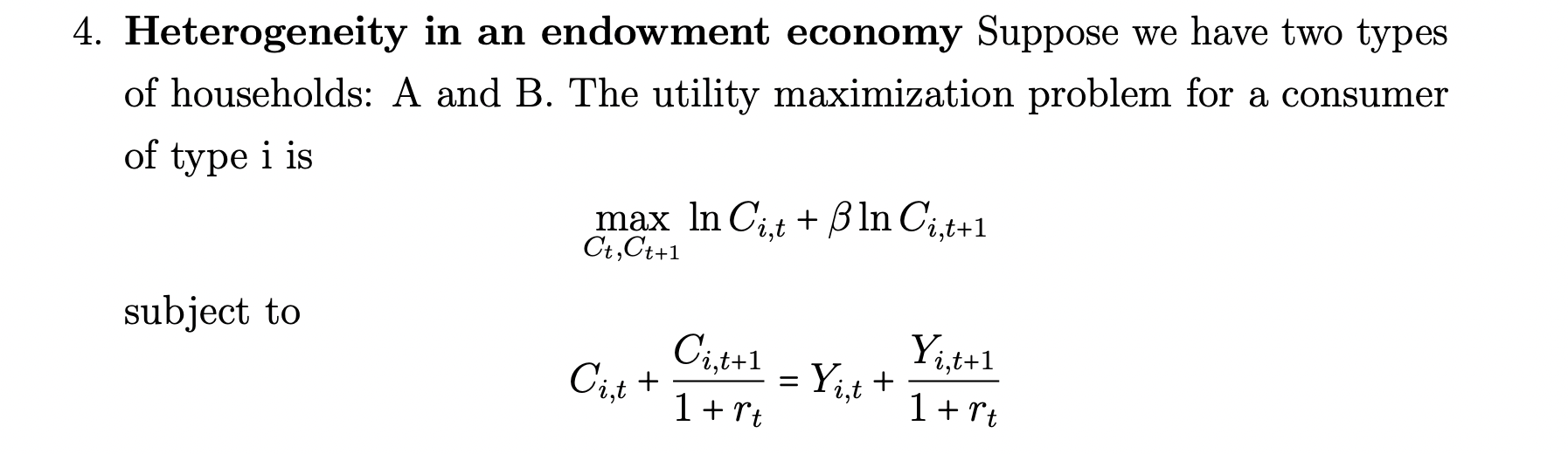
Note that the A and B households have the same discount rate and the same utility function. The only thing that is possibly different is their endowments.
(a) Write down the Euler equation for households A and B.
(b) Solve for the time t and t + 1 consumption functions for households A and B.
(c) Suppose (YA,t, YA,t+1) = (1, 2) and (YB,t, YB,t+1) = (2, 1). Solve for the equilibrium interest rate.
(d) Substitute this market clearing interest rate back into your consumption functions for type A and B households and solve for the equilibrium allocations. Which household is borrowing in the first period and which household is saving? What is the economic intuition for this?
(e) Describe why borrowing and savings occur in this economy, but not the representative household economy. Why does household B have higher consumption in each period?
(f) Assuming β = 0.9 compare the lifetime utility of each type of household when they consume their endowment versus when they consume their equilibrium allocation. That is calculate household A’s utility when it consumes its endowment and compare it to when household A consumes its equilibrium allocation. Which utility is higher? Do the same thing for household B. What is the economic intuition for this result?
Expert Answer
Answer to Heterogeneity in an endowment economy Suppose we have two types of households: A and B. The utility maximization problem …..
OR