
[Solved]E6 14 Points Question Study Possible Oscillation Behavior Dv Algorithm Link Cost Amount Tr Q37166258
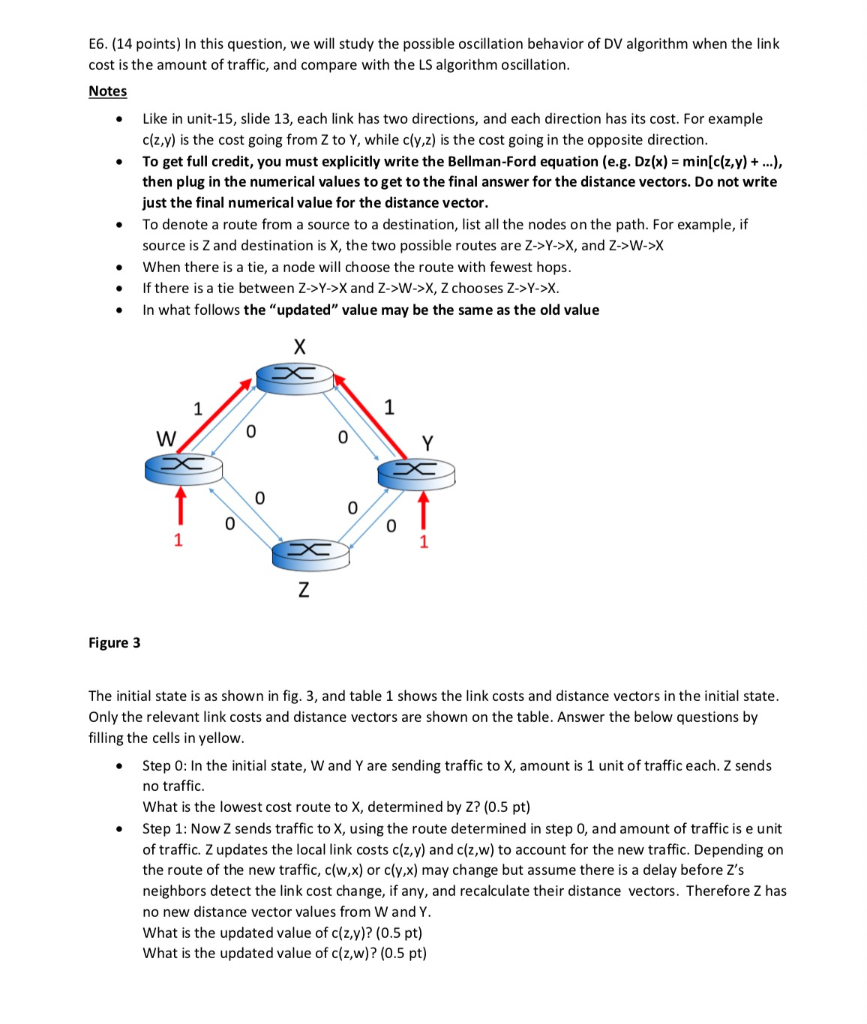
E6. (14 points) In this question, we will study the possible oscillation behavior of DV algorithm when the link cost is the amount of traffic, and compare with the LS algorithm oscillation Notes Like in unit-15, slide 13, each link has two directions, and each direction has its cost. For example c(z,y) is the cost going from Z to Y, while c(y,z) is the cost going in the opposite direction To get full credit, you must explicitly write the Bellman-Ford equation (e.g. Dz(x) min[c(z,y) +…), then plug in the numerical values to get to the final answer for the distance vectors. Do not write just the final numerical value for the distance vector. To denote a route from a source to a destination, list all the nodes on the path. For example, if source is Z and destination is X, the two possible routes are Z->Y->X, and Z->W–Х When there is a tie, a node will choose the route with fewest hops If there is a tie between Z->Y->X and Z->W->X, Z chooses Z->Y->X. . In what follows the “updated” value may be the same as the old value 0 0 0 0 Figure 3 The initial state is as shown in fig. 3, and table 1 shows the link costs and distance vectors in the initial state Only the relevant link costs and distance vectors are shown on the table. Answer the below questions by filling the cells in yellow Step 0: In the initial state, W and Y are sending traffic to X, amount is 1 unit of traffic each. Z sends no traffic What is the lowest cost route to X, determined by Z? (0.5 pt) Step 1: Now Z sends traffic to X, using the route determined in step 0, and amount of traffic is e unit of traffic. Z updates the local link costs c(z,y) and c(z,w) to account for the new traffic. Depending on the route of the new traffic, c(w,x) or c(y,x) may change but assume there is a delay before Z’s neighbors detect the link cost change, if any, and recalculate their distance vectors. Therefore Z has no new distance vector values from W and Y What is the updated value of c(z,y)? (0.5 pt) What is the updated value of c(z,w)? (0.5 pt) Because one or more link cost changed, Z recalculates Dz(x). What is the recalculated value of Dz(x)? (0.5 pt) What is the updated lowest cost route from Z to X, determined by Z? (0.5 pt) Note this updated route will be used only in a subsequent step, but not in this one Step 2: Z reroutes traffic according to the updated route determined in step 1. Z updates the local ink costs c(z,y) and c(z,w) to account for the new traffic. Depending on the route of the new traffic, c(w,x) or c(y,x) may change but assume there is a delay before Z’s neighbors detect the link cost change, if any, and recalculate their distance vectors. Therefore Z has no new distance vector values from W and Y What is the updated value of c(z,y)? (0.5 pt) What is the updated value of c(z,w)? (0.5 pt) Because one or more link cost changed, Z recalculates Dz(x). What is the recalculated value of Dz(x)? (0.5 pt) What is updated lowest cost route from Z to X, determined by Z? (0.5 pt) Note this updated route will be used only in a subsequent step, but not in this one Step 3: Y updates c(w) to account for the traffic after Z has rerouted in step 2. Y receives the D2(x) updated in step 2 by Z. Y updates Dy(x) using the updated c(y,x) and Dz(x) What is the updated c(y,x? (0.5 pt) What is the updated Dy(x)? (0.5 pt) What is the updated lowest cost route from Y to X determined by Y? (0.5 pt) Step 4: Z reroutes traffic according to the updated route determined in step 2. Z updates the local link costs c(z,y) and c(z,w) to account for the new traffic. Depending on the route of the new traffic, c(w,x) or c(y,x) may change but assume there is a delay before Z’s neighbors detect the link cost change, if any, and recalculate their distance vectors. Therefore Z has no new distance vector values from W and Y What is the updated value of c(z,y)? (0.5 pt) What is the updated value of c(z,w)? (0.5 pt) Because one or more link cost changed, Z recalculates Dz(x). What is the recalculated value of Dz(x)? (0.5 pt) What is updated lowest cost route from Z to X, determined by Z? (0.5 pt) Note this updated route will be used only in a subsequent step, but not in this one Step 5: W updates c(w,x) to account for the traffic after Z has rerouted in step 4. W receives the Dz(x) updated in step 4 by Z. W updates Dw(x) using the updated c(w,x) and Dz(x) What is the updated c(w,x)? (0.5 pt) What is the updated Dw(x)? (0.5 pt) What is the updated lowest cost route from W to X determined by W? (0.5 pt) Answer the following questions in essay form (no cell table to fill) Does the traffic from Z to X oscillate? What observed result in what step(s) do you use to justify your answer? (1 pt) Does the traffic from W to X oscillate? what observed result in what step(s) do you use to justify your answer? (1 pt) Does the traffic from Y to X oscillate? What observed result in what step(s) do you use to justify your answer? (1 pt) In this specific scenario, how does the oscillation behavior of DV compare with the one of LS in unit-15, slide 13? Explain why the behavior is different (1.5 pts) c(z,w) by Z 0 Step Dw(x) Dyx) Dzx) C(,y) Lowest ost Lowest cost Lowest cost route toX determined determined determined maintained maintained maintained maintained route toX route toX by Z by Y by W W->X W->X W->X 0 1 0 Y->X 1 1 Y->X Table 1 Show transcribed image text E6. (14 points) In this question, we will study the possible oscillation behavior of DV algorithm when the link cost is the amount of traffic, and compare with the LS algorithm oscillation Notes Like in unit-15, slide 13, each link has two directions, and each direction has its cost. For example c(z,y) is the cost going from Z to Y, while c(y,z) is the cost going in the opposite direction To get full credit, you must explicitly write the Bellman-Ford equation (e.g. Dz(x) min[c(z,y) +…), then plug in the numerical values to get to the final answer for the distance vectors. Do not write just the final numerical value for the distance vector. To denote a route from a source to a destination, list all the nodes on the path. For example, if source is Z and destination is X, the two possible routes are Z->Y->X, and Z->W–Х When there is a tie, a node will choose the route with fewest hops If there is a tie between Z->Y->X and Z->W->X, Z chooses Z->Y->X. . In what follows the “updated” value may be the same as the old value 0 0 0 0 Figure 3 The initial state is as shown in fig. 3, and table 1 shows the link costs and distance vectors in the initial state Only the relevant link costs and distance vectors are shown on the table. Answer the below questions by filling the cells in yellow Step 0: In the initial state, W and Y are sending traffic to X, amount is 1 unit of traffic each. Z sends no traffic What is the lowest cost route to X, determined by Z? (0.5 pt) Step 1: Now Z sends traffic to X, using the route determined in step 0, and amount of traffic is e unit of traffic. Z updates the local link costs c(z,y) and c(z,w) to account for the new traffic. Depending on the route of the new traffic, c(w,x) or c(y,x) may change but assume there is a delay before Z’s neighbors detect the link cost change, if any, and recalculate their distance vectors. Therefore Z has no new distance vector values from W and Y What is the updated value of c(z,y)? (0.5 pt) What is the updated value of c(z,w)? (0.5 pt)
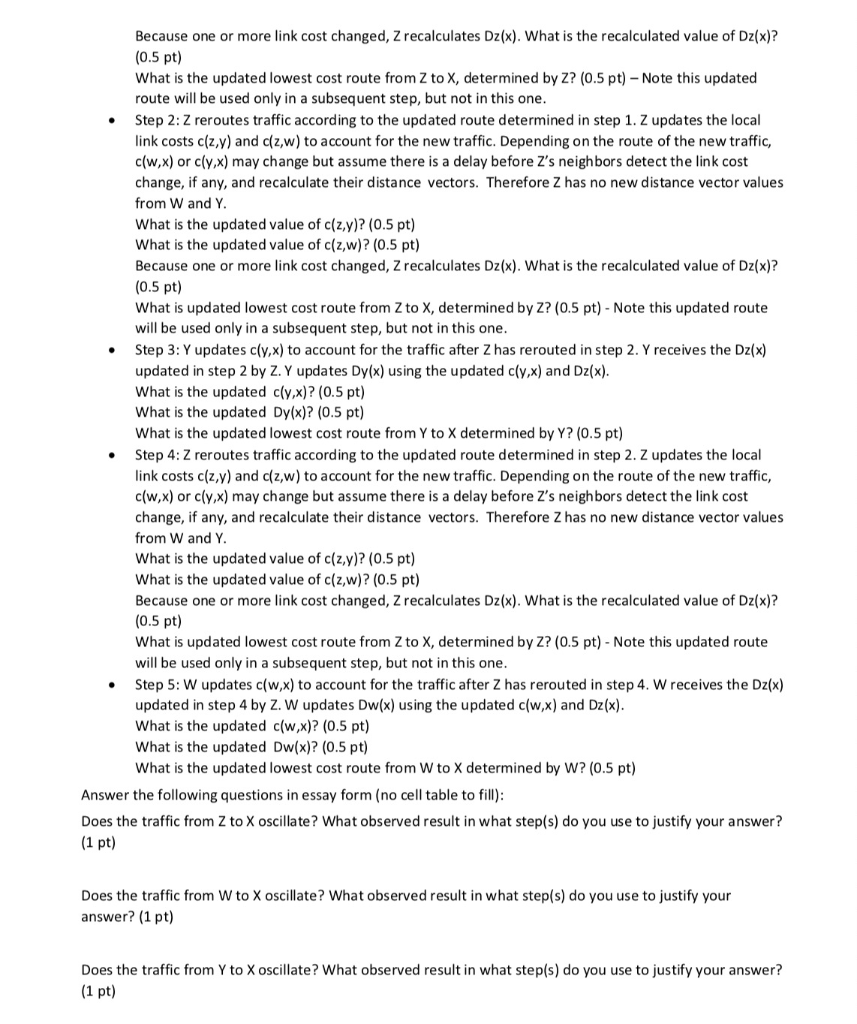
Because one or more link cost changed, Z recalculates Dz(x). What is the recalculated value of Dz(x)? (0.5 pt) What is the updated lowest cost route from Z to X, determined by Z? (0.5 pt) Note this updated route will be used only in a subsequent step, but not in this one Step 2: Z reroutes traffic according to the updated route determined in step 1. Z updates the local ink costs c(z,y) and c(z,w) to account for the new traffic. Depending on the route of the new traffic, c(w,x) or c(y,x) may change but assume there is a delay before Z’s neighbors detect the link cost change, if any, and recalculate their distance vectors. Therefore Z has no new distance vector values from W and Y What is the updated value of c(z,y)? (0.5 pt) What is the updated value of c(z,w)? (0.5 pt) Because one or more link cost changed, Z recalculates Dz(x). What is the recalculated value of Dz(x)? (0.5 pt) What is updated lowest cost route from Z to X, determined by Z? (0.5 pt) Note this updated route will be used only in a subsequent step, but not in this one Step 3: Y updates c(w) to account for the traffic after Z has rerouted in step 2. Y receives the D2(x) updated in step 2 by Z. Y updates Dy(x) using the updated c(y,x) and Dz(x) What is the updated c(y,x? (0.5 pt) What is the updated Dy(x)? (0.5 pt) What is the updated lowest cost route from Y to X determined by Y? (0.5 pt) Step 4: Z reroutes traffic according to the updated route determined in step 2. Z updates the local link costs c(z,y) and c(z,w) to account for the new traffic. Depending on the route of the new traffic, c(w,x) or c(y,x) may change but assume there is a delay before Z’s neighbors detect the link cost change, if any, and recalculate their distance vectors. Therefore Z has no new distance vector values from W and Y What is the updated value of c(z,y)? (0.5 pt) What is the updated value of c(z,w)? (0.5 pt) Because one or more link cost changed, Z recalculates Dz(x). What is the recalculated value of Dz(x)? (0.5 pt) What is updated lowest cost route from Z to X, determined by Z? (0.5 pt) Note this updated route will be used only in a subsequent step, but not in this one Step 5: W updates c(w,x) to account for the traffic after Z has rerouted in step 4. W receives the Dz(x) updated in step 4 by Z. W updates Dw(x) using the updated c(w,x) and Dz(x) What is the updated c(w,x)? (0.5 pt) What is the updated Dw(x)? (0.5 pt) What is the updated lowest cost route from W to X determined by W? (0.5 pt) Answer the following questions in essay form (no cell table to fill) Does the traffic from Z to X oscillate? What observed result in what step(s) do you use to justify your answer? (1 pt) Does the traffic from W to X oscillate? what observed result in what step(s) do you use to justify your answer? (1 pt) Does the traffic from Y to X oscillate? What observed result in what step(s) do you use to justify your answer? (1 pt)
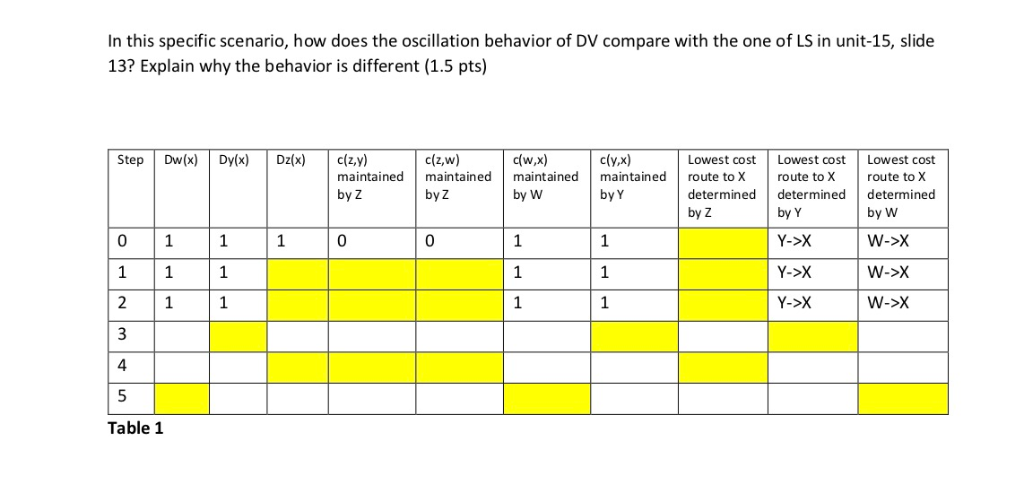
In this specific scenario, how does the oscillation behavior of DV compare with the one of LS in unit-15, slide 13? Explain why the behavior is different (1.5 pts) c(z,w) by Z 0 Step Dw(x) Dyx) Dzx) C(,y) Lowest ost Lowest cost Lowest cost route toX determined determined determined maintained maintained maintained maintained route toX route toX by Z by Y by W W->X W->X W->X 0 1 0 Y->X 1 1 Y->X Table 1
Expert Answer
Answer to E6. (14 points) In this question, we will study the possible oscillation behavior of DV algorithm when the link cost is … . . .
OR