
[Solved]Task 2 Oral Drug Delivery Model Development Simulation Build Discuss Results Computer Simu Q37187501
 pls help with this Matlabquestion
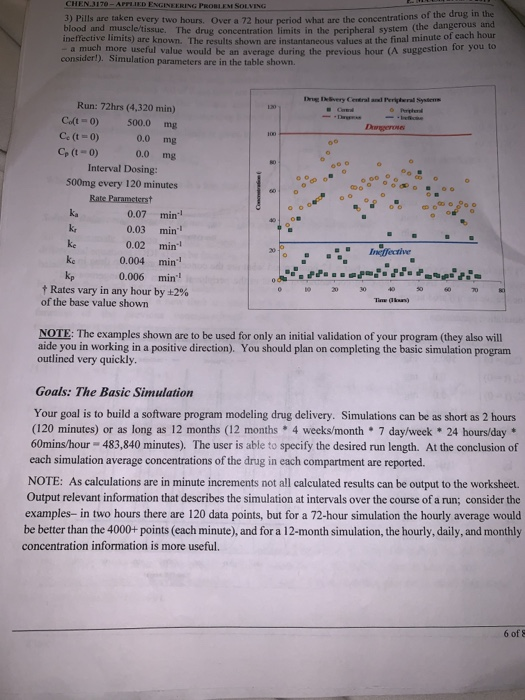
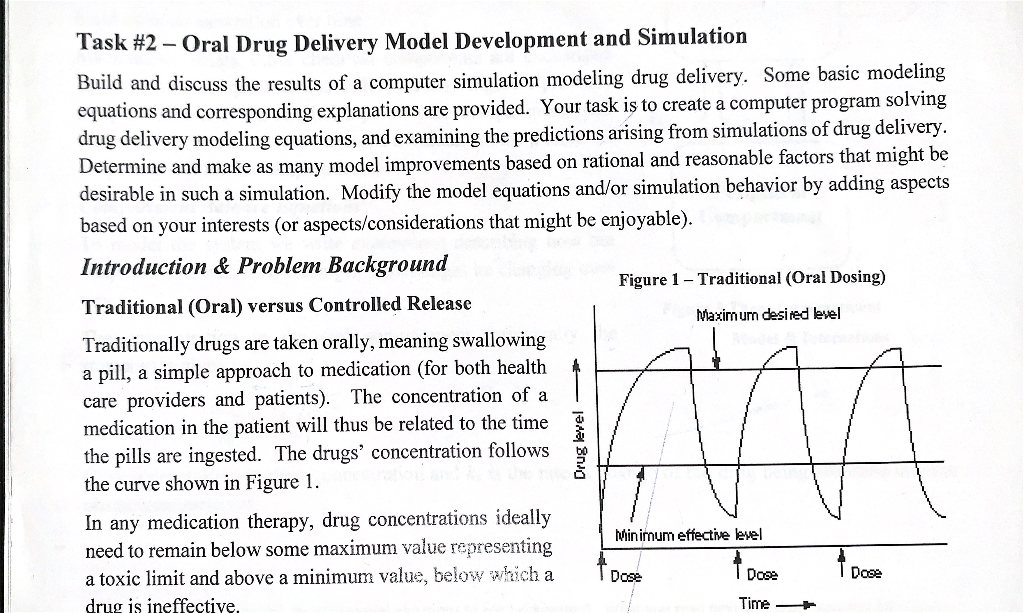
Task #2-Oral Drug Delivery Model Development and Simulation Build and discuss the results of a computer simulation modeling drug delivery. Some equations and corresponding explanations are provided. Your task is to create a computer pr drug delivery modeling equations, and examining the predictions arising from simulations of drug delivery basic modeling ogram solving etermine and ma desirable in such a simulation. Modify the model equations and/or simulation behavior by adding aspects based on your interests (or aspects/considerations that might be enjoyable) s many model improvements based on rational and reasonable factors that might be ke a Introduction & Problem Background Traditional (Oral) versus Controlled Release Traditionally drugs are taken orally, meaning swallowing a pill, a simple approach to medication (for both health care providers and patients). The concentration of a medication in the patient will thus be related to the time the pills are ingested. The drugs’ concentration follows the curve shown in Figure 1. In any medication therapy, drug concentrations ideally need to remain below some maximum value representing Figure 1 – Traditional (Oral Dosing) maximum desited level Minimum effective level a toxie limit and above a minimum value, below which a Des Time drug is ineffective EN.3 170-APPLIED ENGINEERING PROBIBI Soisc Modeling Drug Delivery: One (of many) possible approaches… Modeling the entire human body and all the associated complexities is both beyond the reach simulation technology (not enough computer power!) and there are numerous that remain unknown (chemical reaction pathways-how various react all of reactions that E. MAASE, SPRiNG 2019 of current factors in human physiology reactions relate to one another and not may take place in the body are known, chemical diffusion, external influenes on the body, and much more) and then there are additional uncertainties arising from differences in individuals (even humans of a specific age, gender, and race can differ a great deal from one another), however The first step in the modeling process is to simplify the system into components that might be mathematically described. Following this idea we break the body into regions. One approach is to consider the human body as three compartments, also called the three compartment model (naturally). The three common compartments termed oral, central, and peripheral. Oral Dose considered are The oral compartment represents primarily the mouth and stomach where a drug is gradually dissolving. The central compartment represents both the blood stream (circulatory system) and those organs that are highly perfused (the liver, kidney, lungs, etc.). The peripheral compartment includes muscle and tissues where diffusion of medications is often slower and where drugs may build up in concentration over time. KA ka Central Compartment kE Medications, drugs, other chemical components are exchanged between these compartments at different rates. Figure 3 provides a representation of the relationships between compartments and kp the direction (as well as rate variables, k values, for the transfer ofV drugs to and from the compartments). Peripheral Compartment Compartment Balance Equations To model the system we write expressions describing how the medication in each of the compartments might be changing over Figure 3 Three-Compartment time. The concentration in the oral compartment (principally the stomach) is given by Model & Interactions dt с, is concentration in drug concentration and ka is the rate of change of the drug being absorbed into the central compartment. Don’t worry. Read through the differential equations to see background. What you read next will show you that there is a solution method, one you’ve used before, allowing you to solve these models/ math 3 of 8 CHEN J170-AFFLIED ENGENEERING PROBLEM SOLVING The balance for the central compartment, or Co, is F. MAASE.SPRIN This balance includes the rates/paths for the drug to leave the compartment, where k eliminated from the body, A, is the drug metabolizing, and A is the drug being further absorbed (to peripheral the mpartment) All of these rates are dependent on the concentration of the drug currently in the compartm ent, Co The balance also has terms describing the drug entering from the oral compartment, &”Co, and the drug returning from the peripheral compartment, And peripheral compartment balance is given by C dC Where the concentration in time is a function of the drug entering, keC Solving Balances: Difference Equations ‘too simple’ a solution method? An approximate solution for this system of ordinary differential equations (ODEs) can be found by rewriting the balances as difference equations. Oral Compartment In this method each compartment balance is written as so that the concentrations at a new time are calculated as a function of the previous concentration(s) and the relationships describing changes in concentration The oral dose balance becomes Central Compartment Where the concentration in a new step is based on the d previous concentration and the concentration lost. Similarly, the central compartment balance becomes Peripheral Compartment And the peripheral compartment balance Each term in these equations has been previously de steps (one minute to the next) in the process. Initial values for Co, Cs, and Cp must be known, and concentrations are found by solving equations 1.1, 1.2, and 1.3 in an iterative process in small time steps (each K represents one minute). fined. The index, K, simply describes the individual 4 of 8 We were unable to transcribe this imageWe were unable to transcribe this imageShow transcribed image text Task #2-Oral Drug Delivery Model Development and Simulation Build and discuss the results of a computer simulation modeling drug delivery. Some equations and corresponding explanations are provided. Your task is to create a computer pr drug delivery modeling equations, and examining the predictions arising from simulations of drug delivery basic modeling ogram solving etermine and ma desirable in such a simulation. Modify the model equations and/or simulation behavior by adding aspects based on your interests (or aspects/considerations that might be enjoyable) s many model improvements based on rational and reasonable factors that might be ke a Introduction & Problem Background Traditional (Oral) versus Controlled Release Traditionally drugs are taken orally, meaning swallowing a pill, a simple approach to medication (for both health care providers and patients). The concentration of a medication in the patient will thus be related to the time the pills are ingested. The drugs’ concentration follows the curve shown in Figure 1. In any medication therapy, drug concentrations ideally need to remain below some maximum value representing Figure 1 – Traditional (Oral Dosing) maximum desited level Minimum effective level a toxie limit and above a minimum value, below which a Des Time drug is ineffective
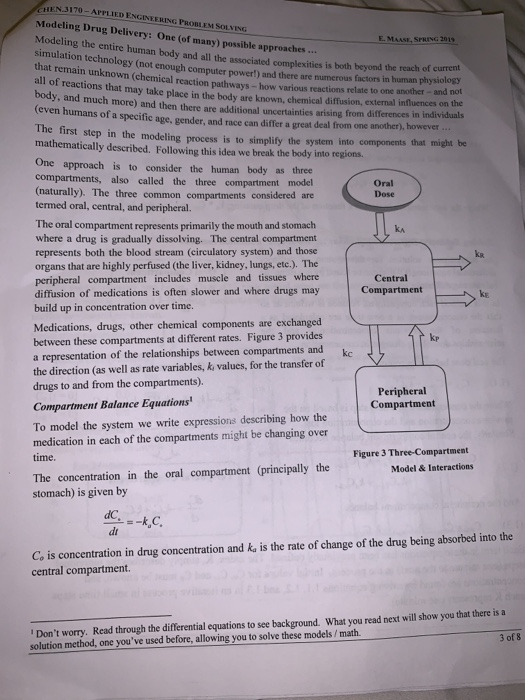
EN.3 170-APPLIED ENGINEERING PROBIBI Soisc Modeling Drug Delivery: One (of many) possible approaches… Modeling the entire human body and all the associated complexities is both beyond the reach simulation technology (not enough computer power!) and there are numerous that remain unknown (chemical reaction pathways-how various react all of reactions that E. MAASE, SPRiNG 2019 of current factors in human physiology reactions relate to one another and not may take place in the body are known, chemical diffusion, external influenes on the body, and much more) and then there are additional uncertainties arising from differences in individuals (even humans of a specific age, gender, and race can differ a great deal from one another), however The first step in the modeling process is to simplify the system into components that might be mathematically described. Following this idea we break the body into regions. One approach is to consider the human body as three compartments, also called the three compartment model (naturally). The three common compartments termed oral, central, and peripheral. Oral Dose considered are The oral compartment represents primarily the mouth and stomach where a drug is gradually dissolving. The central compartment represents both the blood stream (circulatory system) and those organs that are highly perfused (the liver, kidney, lungs, etc.). The peripheral compartment includes muscle and tissues where diffusion of medications is often slower and where drugs may build up in concentration over time. KA ka Central Compartment kE Medications, drugs, other chemical components are exchanged between these compartments at different rates. Figure 3 provides a representation of the relationships between compartments and kp the direction (as well as rate variables, k values, for the transfer ofV drugs to and from the compartments). Peripheral Compartment Compartment Balance Equations To model the system we write expressions describing how the medication in each of the compartments might be changing over Figure 3 Three-Compartment time. The concentration in the oral compartment (principally the stomach) is given by Model & Interactions dt с, is concentration in drug concentration and ka is the rate of change of the drug being absorbed into the central compartment. Don’t worry. Read through the differential equations to see background. What you read next will show you that there is a solution method, one you’ve used before, allowing you to solve these models/ math 3 of 8
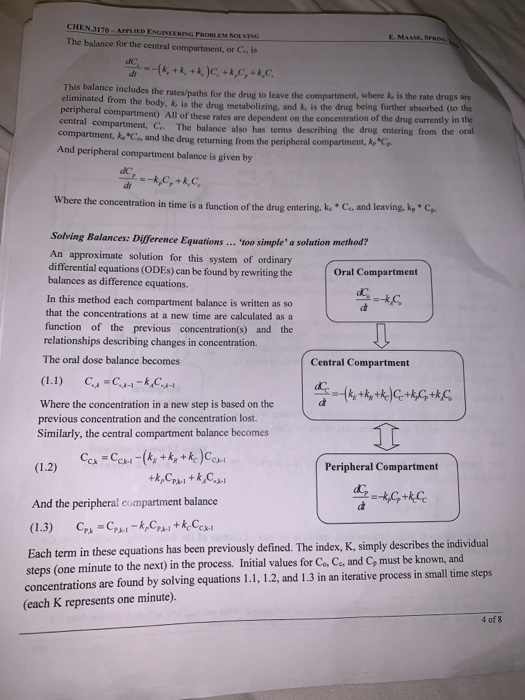
CHEN J170-AFFLIED ENGENEERING PROBLEM SOLVING The balance for the central compartment, or Co, is F. MAASE.SPRIN This balance includes the rates/paths for the drug to leave the compartment, where k eliminated from the body, A, is the drug metabolizing, and A is the drug being further absorbed (to peripheral the mpartment) All of these rates are dependent on the concentration of the drug currently in the compartm ent, Co The balance also has terms describing the drug entering from the oral compartment, &”Co, and the drug returning from the peripheral compartment, And peripheral compartment balance is given by C dC Where the concentration in time is a function of the drug entering, keC Solving Balances: Difference Equations ‘too simple’ a solution method? An approximate solution for this system of ordinary differential equations (ODEs) can be found by rewriting the balances as difference equations. Oral Compartment In this method each compartment balance is written as so that the concentrations at a new time are calculated as a function of the previous concentration(s) and the relationships describing changes in concentration The oral dose balance becomes Central Compartment Where the concentration in a new step is based on the d previous concentration and the concentration lost. Similarly, the central compartment balance becomes Peripheral Compartment And the peripheral compartment balance Each term in these equations has been previously de steps (one minute to the next) in the process. Initial values for Co, Cs, and Cp must be known, and concentrations are found by solving equations 1.1, 1.2, and 1.3 in an iterative process in small time steps (each K represents one minute). fined. The index, K, simply describes the individual 4 of 8
Expert Answer
Answer to Task #2-Oral Drug Delivery Model Development and Simulation Build and discuss the results of a computer simulation model… . . .
OR