
[solved]-Plz Someone Help Question 1 Consider Aussie Make Australian Equipment Manufacturing Compan Q39679728
plz someone help on this Question 1.
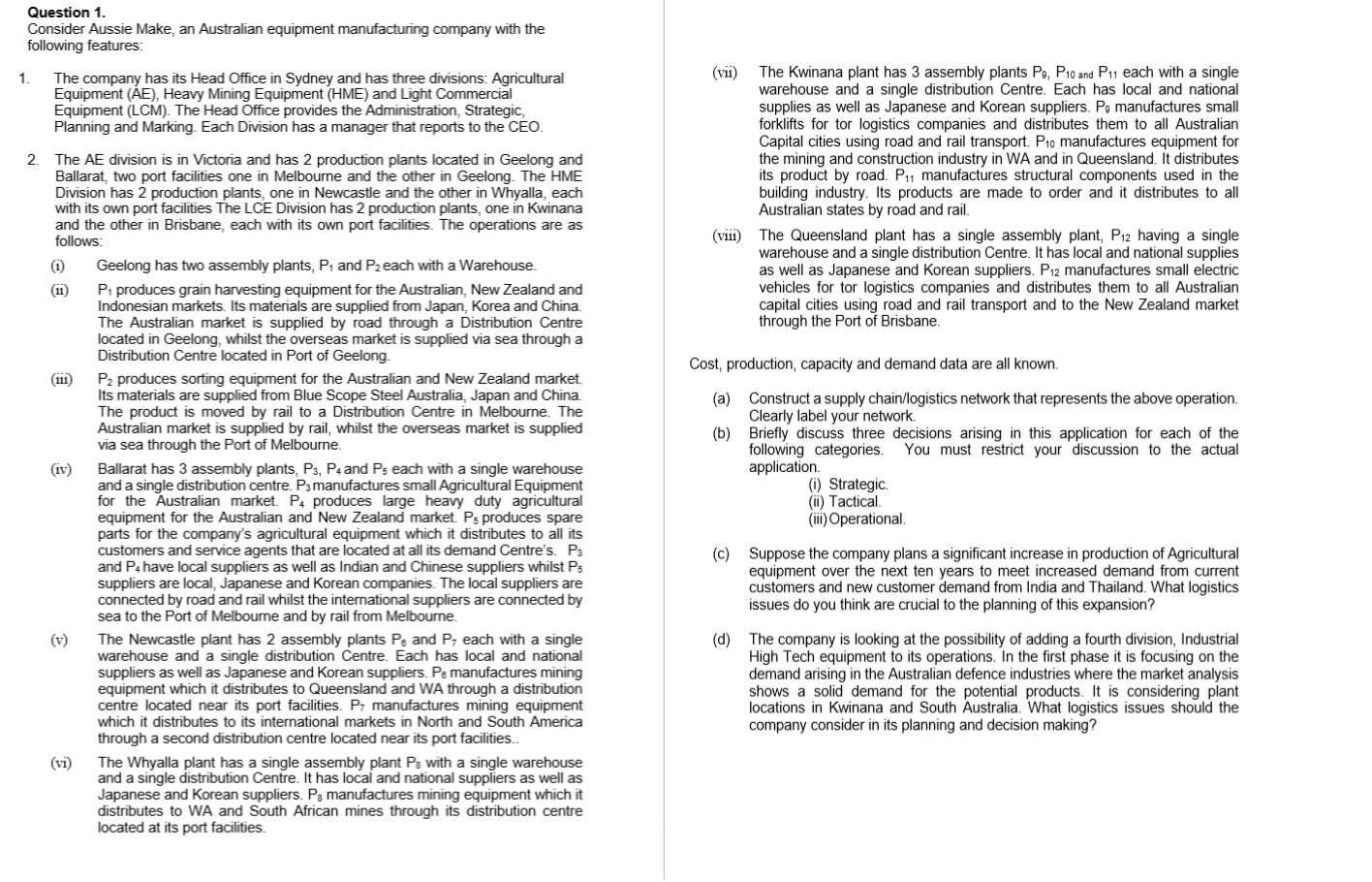 Consider Aussie Make, an Australianequipment manufacturing company with the following features:
1. The company has its Head Office in Sydney and has threedivisions: Agricultural Equipment (AE), Heavy Mining Equipment(HME) and Light Commercial Equipment (LCM). The Head Officeprovides the Administration, Strategic, Planning and Marking. EachDivision has a manager that reports to the CEO.
2. The AE division is in Victoria and has 2 production plantslocated in Geelong and Ballarat, two port facilities one inMelbourne and the other in Geelong. The HME Division has 2production plants, one in Newcastle and the other in Whyalla, eachwith its own port facilities The LCE Division has 2 productionplants, one in Kwinana and the other in Brisbane, each with its ownport facilities. The operations are as follows: (i) Geelong has twoassembly plants, P1 and P2 each with a Warehouse. (ii) P1 producesgrain harvesting equipment for the Australian, New Zealand andIndonesian markets. Its materials are supplied from Japan, Koreaand China. The Australian market is supplied by road through aDistribution Centre located in Geelong, whilst the overseas marketis supplied via sea through a Distribution Centre located in Portof Geelong. (iii) P2 produces sorting equipment for the Australianand New Zealand market. Its materials are supplied from Blue ScopeSteel Australia, Japan and China. The product is moved by rail to aDistribution Centre in Melbourne. The Australian market is suppliedby rail, whilst the overseas market is supplied via sea through thePort of Melbourne. (iv) Ballarat has 3 assembly plants, P3, P4 andP5 each with a single warehouse and a single distribution centre.P3 manufactures small Agricultural Equipment for the Australianmarket. P4 produces large heavy duty agricultural equipment for theAustralian and New Zealand market. P5 produces spare parts for thecompany’s agricultural equipment which it distributes to all itscustomers and service agents that are located at all its demandCentre’s. P3 and P4 have local suppliers as well as Indian andChinese suppliers whilst P5 suppliers are local, Japanese andKorean companies. The local suppliers are connected by road andrail whilst the international suppliers are connected by sea to thePort of Melbourne and by rail from Melbourne. (v) The Newcastleplant has 2 assembly plants P6 and P7 each with a single warehouseand a single distribution Centre. Each has local and nationalsuppliers as well as Japanese and Korean suppliers. P6 manufacturesmining equipment which it distributes to Queensland and WA througha distribution centre located near its port facilities. P7manufactures mining equipment which it distributes to itsinternational markets in North and South America through a seconddistribution centre located near its port facilities.. (vi) TheWhyalla plant has a single assembly plant P8 with a singlewarehouse and a single distribution Centre. It has local andnational suppliers as well as Japanese and Korean suppliers. P8manufactures mining equipment which it distributes to WA and SouthAfrican mines through its distribution centre located at its portfacilities.
FACULTY OF SCIENCE AND ENGINEERING SCHOOL OF ELECTRIICALENGINEERING, COMPUTING AND MATHEMATICAL SCIENCES
2
(vii) The Kwinana plant has 3 assembly plants P9, P10 and P11 eachwith a single warehouse and a single distribution Centre. Each haslocal and national supplies as well as Japanese and Koreansuppliers. P9 manufactures small forklifts for tor logisticscompanies and distributes them to all Australian Capital citiesusing road and rail transport. P10 manufactures equipment for themining and construction industry in WA and in Queensland. Itdistributes its product by road. P11 manufactures structuralcomponents used in the building industry. Its products are made toorder and it distributes to all Australian states by road and rail.(viii) The Queensland plant has a single assembly plant, P12 havinga single warehouse and a single distribution Centre. It has localand national supplies as well as Japanese and Korean suppliers. P12manufactures small electric vehicles for tor logistics companiesand distributes them to all Australian capital cities using roadand rail transport and to the New Zealand market through the Portof Brisbane.
Cost, production, capacity and demand data are all known.
(a) Construct a supply chain/logistics network that represents theabove operation. Clearly label your network. (b) Briefly discussthree decisions arising in this application for each of thefollowing categories. You must restrict your discussion to theactual application. (i) Strategic. (ii) Tactical. (iii)Operational.
(c) Suppose the company plans a significant increase in productionof Agricultural equipment over the next ten years to meet increaseddemand from current customers and new customer demand from Indiaand Thailand. What logistics issues do you think are crucial to theplanning of this expansion?
(d) The company is looking at the possibility of adding a fourthdivision, Industrial High Tech equipment to its operations. In thefirst phase it is focusing on the demand arising in the Australiandefence industries where the market analysis shows a solid demandfor the potential products. It is considering plant locations inKwinana and South Australia. What logistics issues should thecompany consider in its planning and decision making?
Question 1. Consider Aussie Make, an Australian equipment manufacturing company with the following features: 1. (vii) The company has its Head Office in Sydney and has three divisions: Agricultural Equipment (AE), Heavy Mining Equipment (HME) and Light Commercial Equipment (LCM). The Head Office provides the Administration, Strategic, Planning and Marking. Each Division has a manager that reports to the CEO 2. The Kwinana plant has 3 assembly plants Po, P10 and P11 each with a single warehouse and a single distribution Centre. Each has local and national supplies as well as Japanese and Korean suppliers. Po manufactures small forklifts for tor logistics companies and distributes them to all Australian Capital cities using road and rail transport. P10 manufactures equipment for the mining and construction industry in WA and in Queensland. It distributes its product by road. P11 manufactures structural components used in the building industry. Its products are made to order and it distributes to all Australian states by road and rail. The Queensland plant has a single assembly plant, P12 having a single warehouse and a single distribution Centre. It has local and national supplies as well as Japanese and Korean suppliers. P12 manufactures small electric vehicles for tor logistics companies and distributes them to all Australian capital cities using road and rail transport and to the New Zealand market through the Port of Brisbane (vii) Cost, production, capacity and demand data are all known. (a) (b) The AE division is in Victoria and has 2 production plants located in Geelong and Ballarat, two port facilities one in Melbourne and the other in Geelong. The HME Division has 2 production plants, one in Newcastle and the other in Whyalla, each with its own port facilities The LCE Division has 2 production plants, one in Kwinana and the other in Brisbane, each with its own port facilities. The operations are as follows: Geelong has two assembly plants, P4 and P2 each with a Warehouse. P- produces grain harvesting equipment for the Australian, New Zealand and Indonesian markets. Its materials are supplied from Japan, Korea and China. The Australian market is supplied by road through a Distribution Centre located in Geelong, whilst the overseas market is supplied via sea through a Distribution Centre located in Port of Geelong. P2 produces sorting equipment for the Australian and New Zealand market. Its materials are supplied from Blue Scope Steel Australia, Japan and China. The product is moved by rail to a Distribution Centre in Melbourne. The Australian market is supplied by rail, whilst the overseas market is supplied via sea through the Port of Melbourne. (iv) Ballarat has 3 assembly plants, P3, P4 and Ps each with a single warehouse and a single distribution centre. P3manufactures small Agricultural Equipment for the Australian market. P4 produces large heavy duty agricultural equipment for the Australian and New Zealand market. Ps produces spare parts for the company’s agricultural equipment which it distributes to all its customers and service agents that are located at all its demand Centre’s. P3 and P4 have local suppliers as well as Indian and Chinese suppliers whilst Ps suppliers are local, Japanese and Korean companies. The local suppliers are connected by road and rail whilst the international suppliers are connected by sea to the Port of Melbourne and by rail from Melbourne. The Newcastle plant has 2 assembly plants Pe and P, each with a single warehouse and a single distribution Centre. Each has local and national suppliers as well as Japanese and Korean suppliers. Pe manufactures mining equipment which it distributes to Queensland and WA through a distribution centre located near its port facilities. P, manufactures mining equipment which it distributes to its international markets in North and South America through a second distribution centre located near its port facilities. The Whyalla plant has a single assembly plant Ps with a single warehouse and a single distribution Centre. It has local and national suppliers as well as Japanese and Korean suppliers. Pg manufactures mining equipment which it distributes to WA and South African mines through its distribution centre located at its port facilities. Construct a supply chain/logistics network that represents the above operation Clearly label your network. Briefly discuss three decisions arising in this application for each of the following categories. You must restrict your discussion to the actual application (0) Strategic (ii) Tactical (iii) Operational (c) Suppose the company plans a significant increase in production of Agricultural equipment over the next ten years to meet increased demand from current customers and new customer demand from India and Thailand. What logistics issues do you think are crucial to the planning of this expansion? (d) The company is looking at the possibility of adding a fourth division, Industrial High Tech equipment to its operations. In the first phase it is focusing on the demand arising in the Australian defence industries where the market analysis shows a solid demand for the potential products. It is considering plant locations in Kwinana and South Australia. What logistics issues should the company consider in its planning and decision making? Show transcribed image text Question 1. Consider Aussie Make, an Australian equipment manufacturing company with the following features: 1. (vii) The company has its Head Office in Sydney and has three divisions: Agricultural Equipment (AE), Heavy Mining Equipment (HME) and Light Commercial Equipment (LCM). The Head Office provides the Administration, Strategic, Planning and Marking. Each Division has a manager that reports to the CEO 2. The Kwinana plant has 3 assembly plants Po, P10 and P11 each with a single warehouse and a single distribution Centre. Each has local and national supplies as well as Japanese and Korean suppliers. Po manufactures small forklifts for tor logistics companies and distributes them to all Australian Capital cities using road and rail transport. P10 manufactures equipment for the mining and construction industry in WA and in Queensland. It distributes its product by road. P11 manufactures structural components used in the building industry. Its products are made to order and it distributes to all Australian states by road and rail. The Queensland plant has a single assembly plant, P12 having a single warehouse and a single distribution Centre. It has local and national supplies as well as Japanese and Korean suppliers. P12 manufactures small electric vehicles for tor logistics companies and distributes them to all Australian capital cities using road and rail transport and to the New Zealand market through the Port of Brisbane (vii) Cost, production, capacity and demand data are all known. (a) (b) The AE division is in Victoria and has 2 production plants located in Geelong and Ballarat, two port facilities one in Melbourne and the other in Geelong. The HME Division has 2 production plants, one in Newcastle and the other in Whyalla, each with its own port facilities The LCE Division has 2 production plants, one in Kwinana and the other in Brisbane, each with its own port facilities. The operations are as follows: Geelong has two assembly plants, P4 and P2 each with a Warehouse. P- produces grain harvesting equipment for the Australian, New Zealand and Indonesian markets. Its materials are supplied from Japan, Korea and China. The Australian market is supplied by road through a Distribution Centre located in Geelong, whilst the overseas market is supplied via sea through a Distribution Centre located in Port of Geelong. P2 produces sorting equipment for the Australian and New Zealand market. Its materials are supplied from Blue Scope Steel Australia, Japan and China. The product is moved by rail to a Distribution Centre in Melbourne. The Australian market is supplied by rail, whilst the overseas market is supplied via sea through the Port of Melbourne. (iv) Ballarat has 3 assembly plants, P3, P4 and Ps each with a single warehouse and a single distribution centre. P3manufactures small Agricultural Equipment for the Australian market. P4 produces large heavy duty agricultural equipment for the Australian and New Zealand market. Ps produces spare parts for the company’s agricultural equipment which it distributes to all its customers and service agents that are located at all its demand Centre’s. P3 and P4 have local suppliers as well as Indian and Chinese suppliers whilst Ps suppliers are local, Japanese and Korean companies. The local suppliers are connected by road and rail whilst the international suppliers are connected by sea to the Port of Melbourne and by rail from Melbourne. The Newcastle plant has 2 assembly plants Pe and P, each with a single warehouse and a single distribution Centre. Each has local and national suppliers as well as Japanese and Korean suppliers. Pe manufactures mining equipment which it distributes to Queensland and WA through a distribution centre located near its port facilities. P, manufactures mining equipment which it distributes to its international markets in North and South America through a second distribution centre located near its port facilities. The Whyalla plant has a single assembly plant Ps with a single warehouse and a single distribution Centre. It has local and national suppliers as well as Japanese and Korean suppliers. Pg manufactures mining equipment which it distributes to WA and South African mines through its distribution centre located at its port facilities. Construct a supply chain/logistics network that represents the above operation Clearly label your network. Briefly discuss three decisions arising in this application for each of the following categories. You must restrict your discussion to the actual application (0) Strategic (ii) Tactical (iii) Operational (c) Suppose the company plans a significant increase in production of Agricultural equipment over the next ten years to meet increased demand from current customers and new customer demand from India and Thailand. What logistics issues do you think are crucial to the planning of this expansion? (d) The company is looking at the possibility of adding a fourth division, Industrial High Tech equipment to its operations. In the first phase it is focusing on the demand arising in the Australian defence industries where the market analysis shows a solid demand for the potential products. It is considering plant locations in Kwinana and South Australia. What logistics issues should the company consider in its planning and decision making?
Expert Answer
Answer to plz someone help on this Question 1. Consider Aussie Make, an Australian equipment manufacturing company with the follow… . . .
OR